
South Carolina SCDMV Permit Practice Test 21
- Questions30
- Correct to pass24
- Passing score80%
- Minimum age15 years
-
1. You are leaving a freeway at an exit that has a deceleration lane. Where should you slow down?
Show answer
Answer C: After you have moved fully into the exit lane
Braking in a through lane surprises the traffic behind you, so you move into the exit lane at highway speed and then slow down inside it.
-
2. You are behind three slow vehicles on a two-lane road and the way ahead looks clear. What is the sound decision?
Show answer
Answer D: Pass one vehicle at a time, if the road allows it
Passing several vehicles in one move keeps you in the oncoming lane far too long and leaves nowhere to go if a vehicle appears.
-
3. You reach a red light with a sign reading NO TURN ON RED. What may you do?
Show answer
Answer D: Wait for the green; no turn is allowed while the light is red
That sign removes the usual permission to turn on red at the intersection, so you must wait for a green indication.
-
4. A car is coming straight at you in your lane and there is no time for it to move back. What should you do?
Show answer
Answer A: Brake, sound the horn and steer to the right, toward the shoulder or ditch
Steering right takes you away from the other vehicle even if its driver corrects course, and the shoulder or ditch is survivable.
-
5. How is the yield sign shaped and colored?
Show answer
Answer C: A downward-pointing triangle with a wide red border and a red legend on white
The yield sign is a downward-pointing equilateral triangle with a wide red border and the legend in red on a white background, an outline used for no other message.
-
6. In which crash must the police always be notified?
Show answer
Answer D: Any crash in which somebody has been injured or killed, whatever the damage
Injury or death always makes a crash reportable, whatever the amount of vehicle damage or the opinions of the drivers.
-
7. There is a driveway and a side street between you and the corner where you will turn right. When should you signal?
Show answer
Answer C: After passing the openings, so nobody pulls out in front of you
A signal switched on before an opening tells drivers waiting there that you are turning in, and they may pull out into your path.
-
8. Is it a good idea to shift into neutral and coast down a long hill to save fuel?
Show answer
Answer B: No, you lose engine braking and some control of the vehicle
In neutral the engine cannot help slow the vehicle, so the brakes do all the work and can overheat. Stay in gear so the drivetrain helps hold your speed.
-
9. A flashing red lamp is mounted above a stop sign at a rural intersection. What does it add?
Show answer
Answer C: Emphasis, while the required stop stays the same
A stop beacon makes an easily missed stop sign more visible, but it neither adds to nor takes away from the obligation the sign already imposes.
-
10. You reach an uncontrolled intersection at the same moment as a vehicle approaching from your left. What should you do?
Show answer
Answer A: Proceed, but only once you see that driver slowing
You have the right of way over the vehicle on your left, but a right of way is something the other driver has to give, so confirm it before you commit.
-
11. Federal law lets a state open its high-occupancy vehicle lanes to certain vehicles carrying only one person. Which of these is covered by that allowance?
Show answer
Answer B: Motorcycles
Federal law lets states allow motorcycles into high-occupancy vehicle lanes regardless of the number of occupants, because keeping riders in the flow is safer than the alternative.
-
12. Why do bridges and overpasses deserve extra caution when temperatures are near freezing?
Show answer
Answer A: They lose heat from above and below, so they ice over before the surrounding road
A bridge deck is exposed to cold air on both surfaces and has no ground beneath it to hold heat, so ice can form there while the connecting road is still only wet.
-
13. The lane you are in is marked with a straight arrow and a right-turn arrow together. What does that mean?
Show answer
Answer D: Drivers in that lane may either go straight or turn right
A lane marked with two arrows serves both movements, so a driver in it may take either one.
-
14. A curb sign reads No Standing. What does it allow you to do?
Show answer
Answer B: Stop only long enough to pick up or drop off passengers
No Standing bars waiting for any purpose except the brief moment needed to let passengers in or out, which is stricter than No Parking.
-
15. What color scheme does a standard stop sign use?
Show answer
Answer B: White legend and border on a red background
The stop sign carries a white legend and border on a red background, the color set aside for stop, yield and prohibition messages.
-
16. Your vehicle has a blind spot warning light in the door mirror. What should that mean for your habits?
Show answer
Answer B: You still check the blind spot yourself, because the system can miss a rider
Blind spot systems are an aid, not a substitute, and a motorcycle or a bicycle can be missed or arrive faster than the sensor expects.
-
17. You are circulating in the inner lane of a two-lane roundabout, your exit is next, and a vehicle is beside you in the outer lane. What should you do?
Show answer
Answer C: Keep circulating around the island and take that same exit on your next time around
You may not cut across a vehicle in the outer lane; if you cannot exit safely, continue around the circle and try again.
-
18. How many points does a reckless driving conviction add in South Carolina?
Show answer
Answer C: Six points
Reckless driving carries six points, the same value as passing a stopped school bus or a hit-and-run causing only property damage.
-
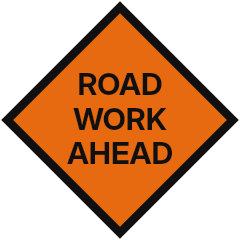
19. Beyond this sign, cones and temporary signs lead traffic along a path that does not agree with the lines painted on the pavement. Which one must the driver follow?
Show answer
Answer C: The temporary arrangement, because it replaces the permanent layout while the work lasts
Temporary traffic control set up for the work takes precedence over the permanent signs and markings, which no longer describe how the road is being used.
-
20. You are waiting to enter a two-lane roundabout and traffic is circulating in both lanes. What must you do?
Show answer
Answer A: Yield to traffic in both circulating lanes before you enter
Every entry to a roundabout is a yield point, and at a two-lane roundabout that means giving way to vehicles in either circulating lane.
-
21. A yield sign is posted where an entrance ramp meets the highway. What must you do?
Show answer
Answer C: Give way to the traffic already on the highway and merge into a gap
The yield sign confirms that the merging driver is the one who must fit into the traffic stream rather than the other way round.
-
22. You are turning left from a two-way street onto a one-way street. Which lane should you enter?
Show answer
Answer C: The first lane open to traffic on the left side of the one-way street
Turn left from the lane closest to the center line and finish in the first available lane on the left of the one-way street, then change lanes if you need to.
-
23. At 45 mph you look at a navigation screen for four seconds. Roughly how far do you travel unseeing?
Show answer
Answer D: About 260 feet
At 45 mph you cover roughly 66 feet a second, so four seconds on a screen is around 260 feet of road that you never looked at.
-
24. Why is parking too close to a street corner prohibited?
Show answer
Answer D: Because it hides approaching traffic and pedestrians
A vehicle parked at a corner blocks the view that both drivers and pedestrians need before entering the intersection.
-
25. Where should you be looking as you steer through a turn?
Show answer
Answer C: Toward the point on the new road where you want to end up
Drivers steer toward what they look at, so looking through the turn to where you want to go keeps the path smooth and accurate.
-
26. The crossbuck, formed by two rectangular arms crossed in an X, is placed
Show answer
Answer D: on each highway approach to a railroad grade crossing
The crossbuck marks the location of a highway-rail grade crossing and is required on each highway approach to that crossing.
-
27. When should you arrange your way home if you plan to drink?
Show answer
Answer C: Before the first drink
Judgment is the first thing alcohol weakens, so the plan has to be made while you can still make a good one.
-
28. You are descending a long steep grade with a loaded truck close behind you. What should you do?
Show answer
Answer A: Hold a steady speed and let it pass when it can
Gravity pushes a loaded truck downhill and it cannot slow quickly, so give it a predictable speed and room to get by rather than braking in front of it.
-
29. How long does a parallel parking space need to be for the car you are driving?
Show answer
Answer D: About five or six feet longer than your vehicle
A few extra feet at each end give you the room to swing in and to straighten up without touching the vehicles in front or behind.
-
30. A stop sign at a busy corner has a stop line and a crosswalk, but buildings block your view of the cross street. What is the correct sequence?
Show answer
Answer C: Stop at the line first, then edge forward and stop again to see
The first stop is required at the line or before the crosswalk, and a second stop farther forward is what actually lets you yield safely.