
South Carolina SCDMV Permit Practice Test 27
- Questions30
- Correct to pass24
- Passing score80%
- Minimum age15 years
-
1. You are approaching a traffic light that has been green for a long time. How should you treat it?
Show answer
Answer C: Expect it to change and be ready to stop
A light that has been green for a while is called a stale green light. Cover the brake and decide in advance where you could still stop safely.
-
2. The car ahead drifts across the lane line and back again several times. What should you do?
Show answer
Answer C: Assume that the driver is distracted or impaired, and keep well back
Drifting is a classic sign of a distracted, drowsy or impaired driver, and distance is your protection from all three.
-
3. An orange sign reads RIGHT LANE CLOSED AHEAD. What is the correct response?
Show answer
Answer A: Move left in good time and keep a steady pace
The sign is placed well before the taper so that drivers can merge smoothly rather than braking hard where the lane actually closes.
-
4. Besides a chemical test, what else supports an impaired driving charge?
Show answer
Answer B: The officer's observations of the driving and the driver
Weaving, slow responses, speech and balance observed by the officer are evidence in their own right, which is why a driver can be charged on behavior alone.
-
5. You are about to pass another vehicle at night with your high beams on. What should you do?
Show answer
Answer C: Switch to low beams as you come up behind it and while you are alongside
High beams shining into the mirrors of the vehicle ahead blind the very driver whose reaction you depend on during the pass.
-
6. A farm implement ahead of you on a two-lane road is wider than its own lane. What should you do?
Show answer
Answer D: Hang back until you can see past it and pass only with a clear road
Wide equipment hides the road ahead and may extend farther across the center line than it appears, so the pass needs more room and a much better view.
-
7. A single solid white line separates two lanes running in the same direction. What is it telling drivers?
Show answer
Answer A: Changing lanes there is discouraged
A solid white lane line discourages lane changing, typically where merging or weaving would create a hazard.
-
8. Why should the washer reservoir hold proper washer fluid rather than plain water in winter?
Show answer
Answer D: Water freezes and it leaves you with no way at all to clean the glass
Washer fluid contains antifreeze, so it still works in the cold, whereas water freezes in the reservoir and the lines.
-
9. What does the implied consent law mean for drivers?
Show answer
Answer D: By driving, you have agreed to a chemical test if lawfully arrested for impaired driving
Holding a license and driving on public roads is treated as consent to breath, blood or urine testing when an officer has grounds to arrest you. Refusing normally brings its own license penalties.
-
10. A raised area crosses the roadway and carries a series of white markings on its face. What are those markings for?
Show answer
Answer A: To make the hump visible so drivers slow for it
Speed hump markings warn drivers that the pavement rises, which matters most at night or when the hump is in shadow.
-
11. Why is being thrown out of a vehicle in a crash so dangerous?
Show answer
Answer C: Because you strike the road or other objects at high speed, and rarely survive
Ejection is one of the deadliest outcomes of a crash, and a fastened belt is what keeps a person inside the vehicle.
-
12. A yellow diamond showing arrows arranged in a circle warns of
Show answer
Answer B: a circular intersection such as a roundabout ahead
The circular intersection warning sign announces a roundabout or traffic circle so drivers can slow down and prepare to yield to traffic already circulating.
-
13. A driver who has been drinking has two cups of strong coffee. What has changed?
Show answer
Answer D: The driver is more awake but just as impaired
Coffee can make a drinker feel alert, but nothing except time removes alcohol from the blood, so a wide awake drinker is still an impaired driver.
-
14. What must a South Carolina teen show regarding school attendance before receiving a conditional or special restricted driver's license?
Show answer
Answer B: That the teen has a high school diploma or GED, or is enrolled and complying with attendance rules while not suspended or expelled
Section 56-1-176 conditions issuance on a diploma or GED, or on compliant enrollment without a current suspension or expulsion.
-
15. A NO LEFT TURN sign carries a plaque reading 7 AM TO 9 AM MON TO FRI. What does the assembly mean?
Show answer
Answer A: The turn is banned only during those hours on those days
A time plaque limits the restriction to the periods shown, so outside those hours and days the left turn may be made normally.
-
16. Why are tall vehicles such as SUVs and vans at extra risk in sudden steering maneuvers?
Show answer
Answer B: Their higher center of gravity makes them more likely to roll over
The higher a vehicle's mass sits, the more it leans in an abrupt turn, and a sharp swerve can tip it over. Smooth, gradual steering inputs are essential in tall vehicles.
-
17. In most states, when are headlights required apart from times of poor visibility?
Show answer
Answer A: From about half an hour after sunset to half an hour before sunrise
Most states require lights from about half an hour after sunset until about half an hour before sunrise, and some simply say sunset to sunrise; lights are also required whenever visibility is poor.
-
18. A signal stands part way up a freeway entrance ramp and turns green briefly again and again. How many vehicles does such a signal normally release on each green?
Show answer
Answer A: One for each lane of the ramp
A ramp control signal releases a single vehicle per lane on each green so that vehicles reach the merge one at a time instead of in a bunch.
-
19. Your right wheels have dropped onto a soft shoulder. Why should you not steer straight back onto the pavement?
Show answer
Answer A: The tires can catch the pavement edge and throw you across the road
A tire pressed against the edge of the pavement climbs it suddenly, and at speed that jolt can send the vehicle across the center line.
-
20. What happens to your field of vision as your speed increases?
Show answer
Answer C: It narrows, so you notice less at the sides of the road
The faster you travel, the more your useful field of view narrows toward the center, so a hazard coming from the side is seen late or missed altogether.
-
21. What fine range applies in South Carolina to a driver who commits highway worker endangerment in a work zone but causes no physical injury?
Show answer
Answer A: Not less than 500 dollars nor more than 1,000 dollars
Section 56-5-1535(B)(1) fines a no-injury highway worker endangerment violation between 500 and 1,000 dollars.
-
22. You leave your car so that its rear overhangs a marked crosswalk. What is wrong with that?
Show answer
Answer B: Pedestrians must step around it into the traffic lane
A crosswalk has to stay completely clear; anything sticking into it pushes people on foot out into the path of moving vehicles.
-
23. Why must you never leave the engine running in a closed garage?
Show answer
Answer B: Because carbon monoxide builds up and can kill within minutes
Exhaust gas contains carbon monoxide, which has no smell or color and can reach fatal levels in an enclosed space very quickly.
-
24. What should you do before leaving a parked vehicle unattended?
Show answer
Answer C: Set the parking brake, place the transmission in park or in gear, switch off the engine and take the key
Securing the vehicle with the parking brake, the transmission and the ignition prevents it from rolling away and from being moved by someone else.
-
25. You back into an unattended parked car in a lot and cause visible damage. What must you do?
Show answer
Answer A: Try to find the owner, or leave a note with your name and contact details, and report the crash
Hitting an unattended vehicle carries the same duties as any crash. Leaving without identifying yourself is a hit-and-run offense.
-
26. Which of these is true of the roadway a driver is being sent onto here?
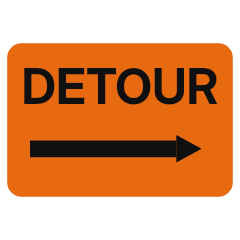
Show answer
Answer D: Its own signs, signals and speed limits govern for the whole way around
The alternate route is an ordinary public road, so every control posted on it governs as usual; being sent that way grants no extra priority and no relief from the limits in force there.
-
27. You are crossing a divided highway with a wide median. How should you treat the two roadways?
Show answer
Answer D: As two intersections, waiting in the median only when your vehicle fits
Each roadway of a divided highway is a separate intersection, and you should wait in the median only if it is long enough to hold your vehicle clear of both roadways.
-
28. You are the first to arrive at a crash on a rural road. What should you do first?
Show answer
Answer C: Park well clear of the scene, put on your hazard lights and call for help
Getting trained help on the way and keeping the scene visible does more good than anything an untrained bystander can do.
-
29. Fresh snow covers the road and earlier vehicles have left clear tracks. What line is usually best?
Show answer
Answer B: The existing tracks, where more of the tire can reach the surface
Running in the cleared tracks puts more rubber on the road surface than ploughing through loose snow, provided the tracks have not turned to polished ice.
-
30. A lane is marked with a large white bicycle symbol and chevrons, but there is no separate bicycle lane. What does it mean?
Show answer
Answer A: Bicyclists may use the whole lane, so follow or pass with care
A shared lane marking shows that bicyclists and drivers use the same lane and positions riders away from parked car doors, so passing means changing lanes.