
South Carolina SCDMV Permit Practice Test 34
- Questions30
- Correct to pass24
- Passing score80%
- Minimum age15 years
-
1. The vehicle you want to pass is traveling close to the speed limit. What should you do?
Show answer
Answer C: Stay behind, because a pass may not take you over the limit
The speed limit applies while passing too. If you cannot complete the pass without exceeding it, do not start the pass.
-
2. Which of these does NOT affect how fast alcohol reaches the bloodstream?
Show answer
Answer A: How confident the drinker feels
Food, the strength of the drinks and the speed of drinking all change how fast alcohol is absorbed, but a drinker's confidence changes nothing at all.
-
3. A motorcycle ahead of you has its turn signal blinking but continues straight through several intersections. What is the likely explanation?
Show answer
Answer D: Motorcycle signals often do not cancel themselves after a turn
Many motorcycle turn signals are not self-cancelling, so a rider may leave one on by mistake. Wait until the rider actually starts to turn before you act on the signal.
-
4. An officer directing traffic faces you and holds one hand up with the open palm toward your vehicle. What does the gesture mean?
Show answer
Answer D: Stop before reaching the officer
A raised open palm shown toward a driver is the standard signal to stop.
-
5. In a work zone, the flagger's instructions conflict with the pavement markings still visible on the road. Which do you follow?
Show answer
Answer B: The flagger, because a person directing traffic outranks the markings
An authorized flagger controlling a temporary traffic control zone overrides signs, signals and markings, and drivers must obey the flagger's signals.
-
6. Loose items slide around your car and rattle every time you brake. What is the answer?
Show answer
Answer C: Secure them before you start driving
Sliding objects pull your attention and can roll under the pedals, so stow them in the trunk or wedge them before the trip rather than chasing them during it.
-
7. What is the what if habit of a defensive driver?
Show answer
Answer C: Thinking through what you would do if a hazard ahead of you turned bad
Rehearsing an answer before the hazard develops means you act at once instead of spending time deciding.
-
8. Before crossing a railroad grade crossing with slow-moving heavy equipment such as a crawler tractor, what does South Carolina law require?
Show answer
Answer C: The operator must notify a railroad station agent in advance and stop between 15 and 50 feet from the nearest rail before proceeding
Section 56-5-2725 requires advance notice to the railroad and a stop between 15 and 50 feet from the nearest rail before such equipment crosses.
-
9. You have signaled and pulled up level with the car in front of an empty curb space. What comes next?
Show answer
Answer A: Reverse slowly while turning the wheel toward the curb
From alongside the forward car you back in on a turn toward the curb, then straighten and swing the front in as the rear reaches the space.
-
10. You are overtaking in a short passing lane on a two-lane road and it is about to end. What must you do?
Show answer
Answer A: Finish the pass and move back to the right before it ends
The added lane ends and the traffic returns to a single lane in each direction, so the pass has to be complete before the pavement runs out.
-
11. The rear of your vehicle begins to slide sideways on a slippery surface. What is the correct correction?
Show answer
Answer C: Ease off the accelerator and steer in the direction you want the front of the vehicle to go
Looking and steering toward your intended path lines the front wheels up with the direction of travel, while sudden braking or a sharp opposite input usually makes the slide worse.
-
12. A driver stopped on suspicion of impaired driving refuses to take a chemical test. What happens?
Show answer
Answer D: A license penalty follows for the refusal itself
Under implied consent, holding a license means agreeing to testing, so a refusal brings its own suspension separately from anything the court decides.
-
13. You have stopped on the shoulder of a busy freeway with a flat tire that you cannot change safely. Where should you and your passengers wait?
Show answer
Answer A: Well away from the traffic side, behind a barrier or up the bank if there is one
People struck on the shoulder are a common cause of roadside deaths, so wait away from the traffic side and behind any barrier.
-
14. The engine dies at speed and the dashboard lights go out on a dark road. What should you do?
Show answer
Answer C: Hold the wheel firmly, steer over to the shoulder and use the hazard lights
Never switch the ignition to lock, because the steering can lock; steer to the shoulder and warn traffic with the hazard lights.
-
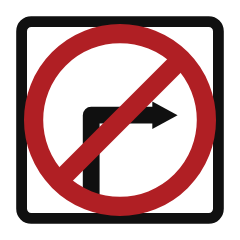
15. A driver's destination lies along the street to the right, and this sign stands at that corner. How should the driver reach it?
Show answer
Answer D: By going on and using a later intersection where turning is allowed
When a movement is barred at one corner the driver has to reroute, normally by continuing and coming back to the destination from a permitted approach.
-
16. You are approaching a marked school crossing and children have started to cross the roadway. What is required?
Show answer
Answer A: Stop and let the children finish crossing the roadway
Drivers give way to people in a marked crossing, stopping if that is what it takes, and children in particular may change direction without warning.
-
17. You are waiting to turn left and a motorcycle is approaching from the opposite direction. Why should you take extra care judging its speed and distance?
Show answer
Answer A: Its small size makes it look farther away and slower than it really is
A motorcycle's narrow profile fools the eye, so drivers often misjudge how soon it will arrive. Left turns across an oncoming motorcycle are a leading cause of rider deaths.
-
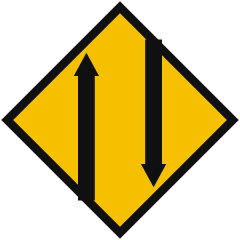
18. Which action becomes clearly more risky beyond this sign?
Show answer
Answer A: Using the left side of the roadway to overtake
With vehicles coming the other way on the same pavement, overtaking on the left needs enough clear road to pull out, pass and return, which is often not available.
-
19. Why should you make sure your turn signal has stopped flashing after a lane change?
Show answer
Answer A: A signal left flashing tells other drivers that you intend to move again
Other drivers act on your signals, so one that is left on gives them false information about what you are about to do.
-
20. What do flashing yellow lights on a school bus mean?
Show answer
Answer A: The bus is about to stop to load or unload, so prepare to stop
The amber lights are the warning phase that comes before the red lights and the stop arm, so drivers should slow down and get ready to stop.
-
21. On a multi-lane street, a yield line is painted well back from an unsignalized crosswalk rather than right at it. Why?
Show answer
Answer D: So drivers in the other lanes can see the pedestrian
Setting the yield line back keeps a stopped vehicle from hiding a crossing pedestrian from drivers in the next lane, which is a common cause of these crashes.
-
22. What happens when alcohol is combined with another drug that also affects the nervous system?
Show answer
Answer B: Impairment is often far greater than either one alone would produce
Combined substances can multiply each other's effects, producing impairment well beyond what a driver would expect from either one taken separately.
-
23. Why can an oncoming vehicle that looks comfortably far away leave you far less room than you expect?
Show answer
Answer D: You and that vehicle close the gap at the sum of both your speeds
Two vehicles approaching at 55 mph each close the distance between them at about 110 mph, so the gap disappears in half the time you would expect.
-
24. Another driver cuts you off and you feel your temper rising. What should you do?
Show answer
Answer A: Take a breath, drop back and let it go, because the whole trip matters more
Retaliation turns a moment of bad driving into a crash, and dropping back costs you only a few seconds.
-
25. At a rural intersection a beacon flashes yellow toward the main road and red toward the side road. How is each approach treated?
Show answer
Answer A: The main road slows and proceeds, the side road stops
An intersection control beacon assigns flashing yellow to the road with priority and flashing red to the approach that must stop and yield.
-
26. The lights at a highway-rail grade crossing begin to flash red as you approach. What must you do?
Show answer
Answer B: Stop short of the tracks and wait until the lights stop and no train is near
Flashing red lights at a crossing require a stop clear of the tracks, and you may proceed only once the lights have stopped, any gates are fully raised and no train is approaching.
-
27. A small yellow plaque showing a speed number below a curve warning sign gives
Show answer
Answer C: the speed recommended for the condition being warned about
The advisory speed plaque belongs to the warning series and states the speed judged safe for the condition ahead under good circumstances, not a regulatory limit.
-
28. How does South Carolina increase the first-offense DUI penalty when the driver's alcohol concentration is 0.16 percent or more?
Show answer
Answer D: The fine rises to 1,000 dollars with 30 to 90 days imprisonment
Section 56-5-2930(A)(1) punishes a first offense at 0.16 percent or above with a 1,000 dollar fine or 30 to 90 days imprisonment.
-
29. You have begun to move into the next lane when the gap you were aiming for closes. What is the safest action?
Show answer
Answer C: Return to your own lane, cancel the signal and wait for a better gap
An unfinished lane change leaves you in a space that no longer exists, and the lane you came from is still yours.
-
30. You want to reverse direction but the street is too narrow for a U-turn. What is the alternative?
Show answer
Answer D: Make a three-point turn, or go around the block in heavy traffic
Where there is not enough width for a U-turn, the three-point turn does the job in stages, and on a busy street going around the block is safer still.