
South Carolina SCDMV Motorcycle Practice Test 11
- Questions30
- Correct to pass24
- Passing score80%
- Minimum age15 years
-
1. What is the South Carolina statutory speed limit on unpaved roads, when no lower limit is separately posted?
Show answer
Answer C: 40 miles per hour
Section 56-5-1520(B)(3) limits unpaved roads to 40 miles per hour, lower than the 55 mph default for other unposted locations.
-
2. A wide crosswalk you are turning across has a refuge island in the middle. What should you assume about people standing on it?
Show answer
Answer D: They may step off the island into your path at any moment
An island is a pause in a crossing, not the end of one, so treat anyone on it as a pedestrian who is still crossing.
-
3. You are overtaking in a short passing lane on a two-lane road and it is about to end. What must you do?
Show answer
Answer A: Finish the pass and move back to the right before it ends
The added lane ends and the traffic returns to a single lane in each direction, so the pass has to be complete before the pavement runs out.
-
4. When should gear changes for a turn be completed?
Show answer
Answer A: Before entering the turn, so the machine stays settled through it
A clumsy shift while leaned over can jerk the rear wheel and break traction, so the right gear should be selected before the lean begins.
-
5. A lane is marked with a large white bicycle symbol and chevrons, but there is no separate bicycle lane. What does it mean?
Show answer
Answer A: Bicyclists may use the whole lane, so follow or pass with care
A shared lane marking shows that bicyclists and drivers use the same lane and positions riders away from parked car doors, so passing means changing lanes.
-
6. At an intersection where every approach carries this sign, two drivers arrive at exactly the same instant. Which of them goes first?

Show answer
Answer C: The driver on the right
Order of arrival decides who goes first, and when two vehicles arrive together the driver on the right proceeds while the other gives way.
-
7. Your vehicle has stalled on railroad tracks and no train is in sight. After getting everyone away, whom should you call first?
Show answer
Answer B: The railroad emergency number posted on the blue sign at the crossing, giving the crossing number
Every public crossing has a blue emergency notification sign with a phone number and a crossing identification number. That call lets the railroad stop or slow trains before they reach you.
-
8. How may a two-way left-turn lane never be used?
Show answer
Answer B: As a through travel lane or a passing lane
The lane exists only for turning movements, so traveling or passing along it puts you head-on with vehicles turning from the opposite direction.
-
9. Where does loose sand and gravel most often collect on a paved road?
Show answer
Answer D: Along the edges of the road and on curves and highway ramps
Traffic sweeps loose material toward the outside of the travel path, so it builds up at the road edges and on curves and on entrance and exit ramps.
-
10. You arrive at an intersection where the traffic signal is completely dark because of a power failure. How should you proceed?
Show answer
Answer C: Treat the intersection as an all-way stop
When a signal shows no indication at all, drivers on every approach must stop and then take turns, exactly as at an all-way stop.
-
11. When are you expected to switch from high beams to low beams?
Show answer
Answer D: When a vehicle approaches from ahead or you come up behind another vehicle
High beams blind other drivers, both those coming toward you and those you follow through their mirrors. Dim them whenever another vehicle is within range.
-
12. What tells you that you are following the rider ahead of you too closely in a group?
Show answer
Answer C: You have stopped being able to see the road surface ahead of them
If the machine ahead blocks your view of the pavement it is about to cross, you will not see a hazard until you are already on it.
-
13. When is a wet road usually most slippery?
Show answer
Answer C: Just after the rain starts, before the surface oil is washed away
Oil and dirt lying on the pavement mix with the first water and cut traction badly until continued rain washes the residue to the side of the road.
-
14. You have just returned to your own lane after passing. Why should you not slow down straight away?
Show answer
Answer A: The vehicle you passed is close behind and needs room to stop
Returning and then braking leaves the driver you just overtook with almost no following distance, which is how a pass turns into a rear-end collision.
-
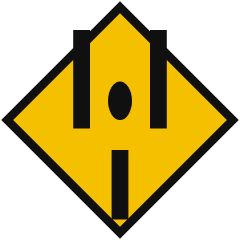
15. Beyond the point this sign refers to, which movement becomes unlawful?
Show answer
Answer D: Driving on the far side of the separation, against the flow
Once the two directions are separated, each roadway carries one-way traffic, so crossing to the other side means driving into oncoming vehicles.
-
16. The neutral light is on, but you are not sure the transmission is really out of gear. How can you confirm it?
Show answer
Answer B: Release the clutch and rock the motorcycle to see whether it rolls freely
A machine that rolls without resistance while the clutch is released is genuinely in neutral, which a burnt out or faulty neutral switch cannot tell you.
-
17. What is the purpose of the padding built into the shoulders, elbows and knees of riding gear?
Show answer
Answer C: It absorbs impact energy at the joints most likely to strike first
Armor at the joints spreads and absorbs the force of an impact in the places that usually hit the ground first in a fall.
-
18. A broken white line separates your lane from the lane on your right. What does it permit?
Show answer
Answer C: Changing lanes when it is safe to do so
A normal broken white line marks a boundary between lanes traveling the same way that road users may cross when it is safe.
-
19. How many points on a South Carolina driving record indicate disrespect for traffic laws and allow the SCDMV to suspend a full license?
Show answer
Answer C: Twelve points
State law treats a total of twelve points as the trigger for suspension of a South Carolina driver license.
-
20. Why should a rider avoid coasting to a stop with the transmission in neutral?
Show answer
Answer C: Engine braking is lost and so is the ability to accelerate out of trouble
Staying in gear keeps engine braking working and leaves the rider able to power away from a hazard instead of hunting for a gear first.
-
21. Two lanes at the corner are marked for right turns. What does that require of you?
Show answer
Answer A: Keep your own lane through the turn and into the matching new lane
Dual turn lanes work only if each vehicle stays in its own lane all the way round and finishes in the corresponding lane of the new street.
-
22. What actually lowers the amount of alcohol in a person's blood?
Show answer
Answer D: The passage of time
The body eliminates alcohol at its own steady rate, so only time reduces blood alcohol. Coffee or a cold shower may make a person feel more awake while still impaired.
-
23. A traffic signal is dark and you reach the intersection at the same moment as a vehicle on your right. Who goes first?
Show answer
Answer A: The vehicle on your right, as at any all-way stop
A dark signal is treated as an all-way stop, and the usual tie-breaker then applies: the vehicle on the right goes first.
-
24. Does South Carolina's distracted driving law apply to a first responder using a mobile electronic device while performing official duties?
Show answer
Answer A: No, first responders performing official duties are exempted from the section
Section 56-5-3890(C)(5) exempts a first responder performing official duties from the section's restrictions.
-
25. A train has just passed a crossing that carries more than one set of tracks. What should you do?
Show answer
Answer B: Wait until the warning devices stop and you can see clearly along every track
A passing train can hide a second one coming on another track, so wait for the signals to clear and check each track before moving.
-
26. You are behind three slow vehicles on a two-lane road and the way ahead looks clear. What is the sound decision?
Show answer
Answer D: Pass one vehicle at a time, if the road allows it
Passing several vehicles in one move keeps you in the oncoming lane far too long and leaves nowhere to go if a vehicle appears.
-
27. You are driving through patchy fog on a highway. What should you be ready for?
Show answer
Answer B: Sudden dense banks where visibility drops within a few car lengths
Patchy fog can go from clear to nearly blind in a moment, so keep your speed low enough that a sudden bank does not leave you without room.
-
28. Why do groups agree on a set of hand signals before setting off?
Show answer
Answer B: Because engine noise and helmets make speech useless between moving machines
Riders cannot talk to each other while moving, so agreed signals for hazards, stops, fuel and single file keep the whole group informed.
-
29. You enter a work zone at night where one lane is closed and a flagger is on duty. What is the safest approach?
Show answer
Answer A: Slow early, merge before the closure and be ready to stop
Merging early at a reduced speed keeps the queue orderly and leaves you room to stop for equipment, workers or traffic that has halted ahead.
-
30. The front brake lever feels soft and travels almost to the handgrip. What should the rider do?
Show answer
Answer D: Leave the motorcycle where it is until the brake system has been inspected
A spongy lever usually means air or fluid loss in the system, and a brake in that condition can fail completely under hard use.