
South Carolina SCDMV Permit Practice Test 3
- Questions30
- Correct to pass24
- Passing score80%
- Minimum age15 years
-
1. A white regulatory sign near a state line reads BUCKLE UP IT IS THE LAW. What is it doing?
Show answer
Answer A: Reminding occupants that belt use is required
The safety belt sign restates a law that already applies, and it is usually placed where drivers enter a state or a long rural stretch.
-
2. You come upon a crash that has just happened and decide to help. Where should you stop your vehicle?
Show answer
Answer A: Well beyond the scene, completely off the road, with the hazard lights on
Stopping past the crash and off the pavement keeps you from becoming another victim and leaves the approach clear for emergency vehicles.
-
3. How should a turn at an intersection be taken on a wet road?
Show answer
Answer C: Slow earlier than usual and steer smoothly through the corner
Wet pavement leaves less grip, so the speed must come off before the turn and the steering must be gentle enough not to break traction.
-
4. You have a green light and are turning right. Pedestrians are stepping off the curb into the crosswalk you are about to cross. What should you do?
Show answer
Answer B: Wait and let them cross before completing your turn
A green light does not release a turning driver from yielding to pedestrians already in the crosswalk of the street being entered.
-
5. You are about to change lanes to the left when you notice a vehicle already overtaking you in that lane. What should you do?
Show answer
Answer A: Hold your lane and your speed, and change only after that vehicle has gone by
A signal asks for space but does not create it, and the overtaking driver has nowhere to go if you move across.
-
6. How does a full load of passengers and luggage affect your braking?
Show answer
Answer B: It lengthens the stopping distance, so you should brake earlier
More weight means more energy to get rid of, so a loaded vehicle takes longer to stop and needs earlier, gentler braking.
-
7. An oncoming vehicle at night has its high beams on and you are being dazzled. Where should you look?
Show answer
Answer A: Toward the right edge of your lane
Looking toward the right edge line keeps you on course while sparing your eyes the worst of the glare. Slow down and do not retaliate with your own high beams.
-
8. You are about to pass a large truck on a two-lane highway. Which practice is correct?
Show answer
Answer A: Finish the pass without delay and expect wind turbulence beside the truck
Lingering beside a truck keeps you in its blind spot and exposes you to air turbulence. Pass on the left, keep moving, and move back only when you can see the whole truck in your mirror.
-
9. You will leave your vehicle for several hours after dark. Where is the best place to park it?
Show answer
Answer D: In a well-lit spot with people and cameras nearby
Light, passing people and cameras all discourage theft and make your own return to the vehicle safer.
-
10. May you park in front of a public or private driveway?
Show answer
Answer A: No, blocking a driveway is prohibited even for a short time
Parking in front of a driveway blocks the property owner from entering or leaving, and the prohibition does not depend on how long you stay.
-
11. Freeway traffic ahead of you has come to a stop. Besides braking early, how can you warn the drivers behind you?
Show answer
Answer B: By switching on the hazard lights for a few seconds
A short burst of hazard lights is a recognized way to tell following traffic that the queue ahead has stopped, and it carries much further back than brake lights. Some states restrict hazard lights on a moving vehicle, so use them only for the moment you are slowing.
-
12. A SHOULDER DROP OFF sign warns that
Show answer
Answer B: there is a step down from the pavement to the shoulder
The sign is used where the edge of the pavement stands several inches above the shoulder, which can grab a wheel and pull the vehicle sideways.
-
13. A sign at the signal reads LEFT TURN ON GREEN ARROW ONLY. The ball turns green but no arrow appears. What may you do?
Show answer
Answer C: Wait, because your turn is allowed only while the arrow is showing
The sign removes the permissive turn, so the left is legal only during the green arrow and you must wait behind the line until it appears.
-
14. A train has just passed a crossing that carries more than one set of tracks. What should you do?
Show answer
Answer B: Wait until the warning devices stop and you can see clearly along every track
A passing train can hide a second one coming on another track, so wait for the signals to clear and check each track before moving.
-
15. You feel drowsy, so you open a window and turn the radio up. What does that achieve?
Show answer
Answer B: Very little, because the drowsiness comes back
Cold air and loud music are not sleep, so the alerting effect lasts a minute or two and the driver is soon just as sleepy and closer to a lapse.
-
16. What is the safe way to carry a dog in a car?
Show answer
Answer C: In a secured crate, or in a harness attached to a seat belt anchor
An unrestrained animal distracts the driver and becomes a heavy projectile in a crash, so it should be crated or harnessed.
-
17. The signal ahead turns yellow while you are approaching it. What does the yellow light mean?
Show answer
Answer C: The red is coming; stop if you can do so safely
A steady yellow warns that the red is next. Stop if you can do so safely; enter the intersection only when stopping would be dangerous.
-
18. How long should a young child ride in a rear-facing child seat?
Show answer
Answer D: Until the child outgrows the height or the weight limit of the seat
Rear facing is the safest position and should be kept until the child reaches the top height or weight allowed by the seat.
-
19. What does a marked crosswalk tell a driver approaching a corner?
Show answer
Answer D: Where pedestrians are expected to cross and must be given way
Crosswalk markings show pedestrians where to cross and warn drivers to yield to anyone using the crossing.
-
20. You are on an entrance ramp merging onto a freeway. Who has to give way?
Show answer
Answer B: You must yield and fit into a gap in the traffic already on the freeway
Traffic entering a highway must yield to traffic already on it. Use the acceleration lane to match speed and merge into a gap.
-
21. You are the first driver on a road just after a storm. What should you plan for?
Show answer
Answer B: Branches, mud and other debris hidden around the next bend
Storm debris lands where nobody has cleared it yet, often just beyond a curve or a crest, so reduce speed and look much further ahead.
-
22. A black and white regulatory sign facing traffic at a divided section reads KEEP LEFT. What does it require?
Show answer
Answer D: Passing the island or obstruction on its left side
Keep Left is posted at an island or obstruction that traffic must pass on the left, which is the opposite of the far more common Keep Right situation.
-
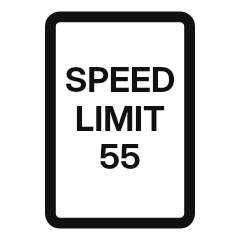
23. Heavy rain has left standing water on the road where this sign is posted. What does the law expect of the driver?
Show answer
Answer C: Driving below the posted figure, at a speed that suits the conditions
Drivers must adapt to conditions, so in rain, fog, snow or dense traffic the safe speed falls below the posted maximum and keeping to that maximum can itself be an offense.
-
24. What is the correct order of a pass on a two-lane road?
Show answer
Answer A: Check ahead and behind, signal left, move out, accelerate past, signal right and return
A pass begins with the decision that the road is clear and ends with a signaled return, and each step warns other drivers before the vehicle moves.
-
25. Is it safe to check your phone while stopped at a red light?
Show answer
Answer B: No, you may miss the signal change and hazards around you
Attention does not return instantly when the light changes, and emergency vehicles, pedestrians or a rear-end threat can appear while you are stopped. Stay focused on the road.
-
26. Why is it dangerous to make a left turn from the second lane from the center?
Show answer
Answer C: Because a driver in the lane beside you is turning into the same space
Drivers in the proper turn lane are entitled to that space, and turning across them puts two vehicles into one path through the intersection.
-
27. A flagger turns the paddle to the orange face reading SLOW. What does that tell approaching drivers?
Show answer
Answer D: Reduce speed and continue through the work area with care
The SLOW face keeps traffic moving at a reduced speed while workers or equipment are close to the travel lanes.
-
28. On a long, straight highway you feel your attention fading. What helps you stay alert?
Show answer
Answer A: Keep your eyes moving, scan mirrors and signs, and take regular breaks
Staring at one point brings on highway hypnosis. Active scanning keeps the mind engaged, and a break every couple of hours restores alertness.
-
29. A yellow pennant, an isosceles triangle with its long axis horizontal, is reserved for which message?
Show answer
Answer D: No passing zone
The pennant shape is used only for the no passing zone sign, which marks the point where overtaking is no longer allowed.
-
30. How does a wet road change the distance you need to stop?
Show answer
Answer C: It lengthens it, so you need a much bigger gap ahead
Water between the tire and the road cuts grip, so braking distance grows and the gap that works on dry pavement is no longer enough.