
South Carolina SCDMV Permit Practice Test 4
Test 4 of 10. Pick an answer for each question to see if it is right and why; your score appears at the end. You need 24 correct answers to pass, the same ratio as the real South Carolina test.
- Questions30
- Correct to pass24
- Passing score80%
- Minimum age15 years
-
1. A flagger in a work zone turns a paddle so that the red octagonal face reading STOP is toward you. What must you do?
Show answer
Answer A: Stop completely and wait for the flagger to signal you forward
The STOP face of a flagger paddle requires a complete stop, and you may move again only when the flagger directs you to.
-
2. Is dictating a message by voice a safe alternative to typing one?
Show answer
Answer C: No, it still takes attention from driving
Composing and checking a spoken message loads the mind and usually pulls the eyes to the screen anyway, so research finds it no safer than other phone use.
-
3. What is the general minimum age for an unrestricted South Carolina driver's license, and what exception lets a driver qualify earlier?
Show answer
Answer C: The general minimum is 17, but a 16 year old may qualify after one year on a conditional license with no traffic conviction or at-fault crash
Section 56-1-40(1) sets 17 as the general minimum, while allowing a clean-record conditional license holder to receive a full license at 16.
-
4. When must a South Carolina special restricted license holder be accompanied by a licensed adult who is at least 21?
Show answer
Answer A: After 6 p.m., or after 8 p.m. during daylight saving time
The special restricted license is valid for daylight driving, and after 6 p.m. (8 p.m. during daylight saving time) a licensed adult 21 or older must accompany the holder.
-
5. What is the base penalty range for a first DUI conviction in South Carolina when the driver's alcohol concentration is below 0.10 percent?
Show answer
Answer C: A 400 dollar fine or 48 hours to 30 days imprisonment
Section 56-5-2930(A)(1) sets the base first-offense DUI penalty at a 400 dollar fine or 48 hours to 30 days in jail, with public service allowed in place of the minimum jail time.
-
6. Does using a hands free device remove the risk of distraction?
Show answer
Answer A: No, the conversation still takes attention away from driving
Hands free equipment removes the manual part of the distraction but not the mental part, and a driver deep in conversation can look straight at a hazard without registering it.
-
7. An emergency vehicle with flashing lights and a siren is approaching from behind on a two-way street. What should you do?
Show answer
Answer C: Pull over to the right edge of the road and stop until it passes
Clearing a path by pulling to the right and stopping gives the emergency vehicle a predictable route, while stopping in mid-lane or inside an intersection blocks that path.
-
8. What is the maximum speed in a South Carolina urban district when nothing else is posted?
Show answer
Answer C: 30 miles per hour
State law fixes 30 miles per hour as the maximum in an urban district, although a local authority may set a lower figure after an engineering study.
-
9. What does a steady yellow traffic light tell the driver facing it?
Show answer
Answer A: The green movement is ending and a red indication is about to appear
A steady yellow warns that the related green movement is being terminated and that red will follow, so you should stop if you can do so safely.
-
10. When may a South Carolina beginner's permit holder practice with a licensed driver who is at least 21 and has a year of experience in the front seat?
Show answer
Answer A: From 6 a.m. to midnight
The Class D beginner's permit allows practice driving between 6 a.m. and midnight with that supervising driver; between midnight and 6 a.m. a person listed in SC Code 56-1-100(A)(1-7) must supervise.
-
11. What does a yield sign require of a driver?
Show answer
Answer A: Slow down, and stop when necessary, so conflicting traffic can go first
A yield sign obliges the driver to reduce to a speed suited to conditions and to stop when needed so that conflicting traffic or pedestrians are not interfered with.
-
12. On a two-lane road, a solid yellow line runs on your side of the center while a broken yellow line runs on the other side. What does this mean?
Show answer
Answer D: You may not pass, although oncoming drivers may
Passing restrictions are read from the line closest to your own lane, so a solid yellow line on your side creates a no-passing zone for you alone.
-
13. What is the penalty for a first offense of illegally passing a stopped South Carolina school bus?
Show answer
Answer B: A fine of not less than 500 dollars, or up to 30 days imprisonment
Section 56-5-2780(A) sets a first-offense fine of at least 500 dollars, or up to 30 days imprisonment, with community service as an option.
-
14. What is the best way to keep your phone from distracting you on a trip?
Show answer
Answer D: Silence it and stow it before you start
A phone you cannot hear and cannot reach cannot tempt you, which is far more reliable than deciding case by case while you drive.
-
15. Which family of signs normally uses a rectangle that is wider than it is tall?
Show answer
Answer B: Guide signs, which name routes and destinations
Guide signs are laid out as horizontal rectangles because they have to carry route numbers, place names and distances side by side.
-
16. What is the lowest speed limit a South Carolina local authority may set outside an urban district after an engineering and traffic investigation?
Show answer
Answer B: 35 miles per hour
Section 56-5-1540(a)(3) prevents a local authority from decreasing the limit outside an urban district below 35 miles per hour.
-
17. A streetcar is coming along tracks in the middle of the street as you wait to turn across them. What should you do?
Show answer
Answer A: Let the streetcar pass before you cross the tracks
Rail vehicles cannot steer around you and need a long distance to stop, so drivers yield to a streetcar or light rail train.
-
18. You feel drowsy, so you open a window and turn the radio up. What does that achieve?
Show answer
Answer B: Very little, because the drowsiness comes back
Cold air and loud music are not sleep, so the alerting effect lasts a minute or two and the driver is soon just as sleepy and closer to a lapse.
-
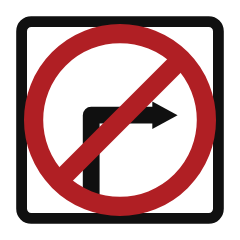
19. A driver stopped at a red signal wants to turn right and this sign is posted at the corner. What is permitted?
Show answer
Answer A: Nothing: the turn is barred whether the signal is red or green
The restriction works independently of the signal, so the usual permission to turn right after stopping at a red light does not exist where this sign is posted.
-
20. You are parking on a one-way street where parking is allowed on both sides. What must still be true?
Show answer
Answer D: The vehicle must face the direction the traffic flows
Either curb may be used on a one-way street where signs allow it, but the vehicle must always be headed in the direction traffic moves.
-
21. Why can a motorcycle ahead of you slow down without any warning light showing?
Show answer
Answer B: The rider may slow by downshifting or rolling off
Riders often lose speed by closing the throttle or changing down, which does not switch on the brake light, so watch the machine itself and keep back.
-
22. The lights at a highway-rail grade crossing begin to flash red as you approach. What must you do?
Show answer
Answer B: Stop short of the tracks and wait until the lights stop and no train is near
Flashing red lights at a crossing require a stop clear of the tracks, and you may proceed only once the lights have stopped, any gates are fully raised and no train is approaching.
-
23. Which shape is used for the school advance warning sign and the school crossing sign?
Show answer
Answer B: An upward-pointing pentagon
The five-sided pentagon with its point up identifies school signing, so the outline alone tells a driver that children may be present.
-
24. May you park across the entrance to a fire station?
Show answer
Answer D: No, an emergency exit must never be blocked
Emergency vehicles must be able to leave the moment a call comes in, so their entrances and exits are kept clear at all hours.
-
25. Before crossing a railroad grade crossing with slow-moving heavy equipment such as a crawler tractor, what does South Carolina law require?
Show answer
Answer C: The operator must notify a railroad station agent in advance and stop between 15 and 50 feet from the nearest rail before proceeding
Section 56-5-2725 requires advance notice to the railroad and a stop between 15 and 50 feet from the nearest rail before such equipment crosses.
-
26. What minimum suspension applies in South Carolina to a driver who takes the test and registers 0.15 percent or more?
Show answer
Answer D: At least one month, with an ignition interlock option to end it
The implied consent notice states that a reading of fifteen one-hundredths of one percent or more brings a suspension of at least one month, which may be ended by enrolling in the Ignition Interlock Device Program.
-
27. On a street with parking along the curb, the shared lane marking is painted well out from the curb face. What does that placement tell a bicyclist?
Show answer
Answer C: To ride clear of the doors of parked cars
The marking is set at least eleven feet from the curb where parking is allowed so that riders are guided outside the reach of an opening door.
-
28. How may a two-way left-turn lane never be used?
Show answer
Answer B: As a through travel lane or a passing lane
The lane exists only for turning movements, so traveling or passing along it puts you head-on with vehicles turning from the opposite direction.
-
29. A flashing red arrow is displayed for your turning lane. What does it require?
Show answer
Answer D: Stopping, then turning when the way is clear
A flashing red arrow is treated like a stop sign for that movement: come to a full stop, then turn when it is safe and no one has to be cut off.
-
30. Besides the half-hour-after-sunset-to-half-hour-before-sunrise window, when else does South Carolina require a vehicle's lamps to be lit?
Show answer
Answer A: Any other time windshield wipers are in use because of rain, sleet, or snow, except intermittent use in misting weather
Section 56-5-4450(A) extends the lighting requirement to whenever wipers are in use for rain, sleet, or snow, with an exception for intermittent use in misting conditions.