
South Carolina SCDMV Permit Practice Test 1
Test 1 of 10. Pick an answer for each question to see if it is right and why; your score appears at the end. You need 24 correct answers to pass, the same ratio as the real South Carolina test.
- Questions30
- Correct to pass24
- Passing score80%
- Minimum age15 years
-
1. What does South Carolina law say about blocking access to an emergency scene?
Show answer
Answer A: Motor vehicles and bystanders may not block access to or exit from an emergency scene
Section 56-5-1538(C) forbids motor vehicles and bystanders from blocking access to, or exit from, an emergency scene.
-
2. How do strong emotions affect driving?
Show answer
Answer B: They narrow your attention and make risky decisions more likely
Anger, worry and excitement all take attention away from the driving task and push drivers toward decisions they would not normally make.
-
3. You have parked a manual transmission car facing downhill. Which gear should you leave it in?
Show answer
Answer D: Reverse, along with the parking brake set firmly
Facing downhill the car would roll forward, so reverse gear opposes that movement while the parking brake and turned wheels back it up.
-
4. Which of these makes you unpredictable to other drivers?
Show answer
Answer B: Changing lanes suddenly without signaling, to save a moment
An unsignalled, sudden lane change gives nobody time to react and is a common cause of sideswipe collisions.
-
5. Crossing a parking lot on a hot day, you see a young child alone in a locked car. What should you do?
Show answer
Answer A: Call 911 right away and stay with the vehicle
The inside of a parked car can reach lethal temperatures within minutes, so a child left alone in one is an emergency.
-
6. Besides a certificate of insurance, what other methods does South Carolina law accept for proving financial responsibility?
Show answer
Answer B: A bond, or a certificate of deposit of money or securities
Section 56-9-540 lists a certificate of insurance, a bond, or a deposit of money or securities as the accepted ways to prove financial responsibility.
-
7. Under South Carolina's Ignition Interlock Device Program, when may a person drive an employer-owned vehicle without the device installed?
Show answer
Answer C: When driving the employer's vehicle is required by the job and used solely for the employer's business
Section 56-5-2941(A)(1) exempts a person from installing the device on an employer's vehicle when its use is solely for the employer's business.
-
8. Besides holding the device, what does South Carolina's distracted driving law specifically prohibit a driver from doing with a mobile electronic device while the vehicle is moving?
Show answer
Answer B: Reading, composing, or transmitting a text, email, or app interaction, and watching video content
Section 56-5-3890(B)(2)-(3) separately bans reading, composing, or transmitting text-based content and watching video, movies, games, or video calls.
-
9. You have printed directions or paperwork you need to check. When should you read them?
Show answer
Answer C: Before you leave, or after you park
Reading takes eyes and mind off the road for far longer than any safe glance, and a light that changes while you read leaves you moving off blind.
-
10. Cannabis is legal for adults in some states. What does that mean for driving?
Show answer
Answer C: Driving while impaired by it is still an offense
Legal possession has nothing to do with driving law, and every state treats driving while impaired by cannabis as an offense.
-
11. You are entering a freeway using an on-ramp with an acceleration lane. What is the correct technique?
Show answer
Answer C: Use the acceleration lane to reach the speed of traffic, then merge into a gap while yielding to traffic already on the freeway
The acceleration lane exists so you can match the speed of freeway traffic before merging, and drivers already on the freeway have the right-of-way.
-
12. How many points does South Carolina add to a driving record for following another vehicle too closely?
Show answer
Answer C: Four points
Section 56-1-720 lists following too closely at four points, the same value used for unlawful passing.
-
13. The passenger-side mirror on most vehicles is convex. What does this mean for the driver?
Show answer
Answer D: Vehicles in that mirror are closer than they appear
A convex mirror gives a wider view but shrinks what it shows, so a vehicle looks smaller and therefore farther away than it really is. Allow for this before changing lanes.
-
14. May a South Carolina judge suspend any part of the minimum jail sentence for a DUI conviction under Section 56-5-2930?
Show answer
Answer B: No, no part of the statutory minimum sentence may be suspended
Section 56-5-2930(B) states that no part of the minimum sentences in that section may be suspended.
-
15. What fine range applies in South Carolina to a driver who commits highway worker endangerment in a work zone but causes no physical injury?
Show answer
Answer A: Not less than 500 dollars nor more than 1,000 dollars
Section 56-5-1535(B)(1) fines a no-injury highway worker endangerment violation between 500 and 1,000 dollars.
-
16. What fine range applies when a highway worker endangerment violation is the sole cause of great bodily injury to the worker?
Show answer
Answer B: Not less than 2,000 dollars nor more than 5,000 dollars
Section 56-5-1535(B)(3) sets a 2,000 to 5,000 dollar fine when the endangerment causes great bodily injury to the worker.
-
17. You are about to pass a large truck on a two-lane highway. Which practice is correct?
Show answer
Answer A: Finish the pass without delay and expect wind turbulence beside the truck
Lingering beside a truck keeps you in its blind spot and exposes you to air turbulence. Pass on the left, keep moving, and move back only when you can see the whole truck in your mirror.
-
18. How long must the ignition interlock device stay installed to end a second-offense DUI suspension in South Carolina?
Show answer
Answer B: Two years
Section 56-5-2990(A)(3) requires two years of interlock use to end a second-offense suspension.
-
19. You have stopped on an uphill grade close behind a large truck at a traffic signal. What is the risk?
Show answer
Answer B: The truck may roll back into you when it starts to move
Heavy vehicles can roll backward a short distance when the driver moves from the brake to the accelerator on a hill. Leave extra room when stopped behind a truck on a grade.
-
20. A driver who has been drinking has two cups of strong coffee. What has changed?
Show answer
Answer D: The driver is more awake but just as impaired
Coffee can make a drinker feel alert, but nothing except time removes alcohol from the blood, so a wide awake drinker is still an impaired driver.
-
21. How do worn tires and worn brakes affect your ability to stop?
Show answer
Answer C: They lengthen the stopping distance, especially on a wet road
Worn tread cannot clear water and worn brakes cannot produce full force, so both stretch the distance needed to stop.
-
22. You have stopped after a crash. Why should the engines of the vehicles involved be switched off?
Show answer
Answer A: To reduce the risk of a fire starting around any fuel that has spilled
Crashes often break fuel lines, and a running engine is a source of ignition, so switching off lowers the risk of fire.
-
23. A steady green arrow pointing left is displayed for your turning lane. What does it tell you?
Show answer
Answer D: The turn is protected because conflicting traffic is being held
A steady green arrow gives a protected movement in the direction shown, although you still yield to pedestrians and to any vehicle already inside the intersection.
-
24. A pedestrian steps off the curb in the middle of a block where there is no crosswalk at all. What is the legal position?
Show answer
Answer A: They must yield to you, but you must still avoid a crash
A pedestrian crossing away from a crosswalk yields to vehicles, yet every driver still has a duty to use care and avoid hitting a person.
-
25. Which of these fits South Carolina's statutory definition of a 'mobile electronic device' for the hands-free law?
Show answer
Answer A: A cellular telephone, portable computer, GPS receiver, or electronic game
Section 56-5-3890(A) defines a mobile electronic device to include a cellular telephone, portable computer, GPS receiver, or electronic game, while expressly excluding CB radios, commercial two-way radios, and prescribed medical devices.
-
26. What actually lowers the amount of alcohol in a person's blood?
Show answer
Answer D: The passage of time
The body eliminates alcohol at its own steady rate, so only time reduces blood alcohol. Coffee or a cold shower may make a person feel more awake while still impaired.
-
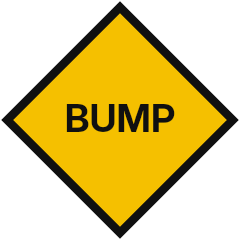
27. Why does this warning matter more on a motorcycle than in a car?
Show answer
Answer B: Because a sudden jolt can unsettle a two-wheeled machine and the rider can lose control
A jolt can push a motorcycle off line or lift a wheel, so a rider slows early, comes slightly off the seat and keeps a relaxed but firm hold on the handlebars.
-
28. You park a manual transmission car facing uphill at a curb. What is the correct combination?
Show answer
Answer A: First gear, wheels turned away from the curb, parking brake set
Facing uphill the car would roll back, so first gear resists that, the wheels turned out let a tire catch the curb, and the parking brake holds it.
-
29. Your brake pedal sinks to the floor and the vehicle does not slow down. What is a reasonable sequence of actions?
Show answer
Answer C: Pump the pedal, shift to a lower gear and apply the parking brake gradually while steering to a safe spot
Pumping can rebuild pressure in a partly failed system, a lower gear adds engine braking, and easing on the parking brake slows the vehicle without locking the wheels.
-
30. You are waiting inside the intersection to turn left when your light turns red. What should you do?
Show answer
Answer A: Complete the turn as soon as the way is clear
Once you have legally entered the intersection you should clear it as soon as the oncoming traffic has stopped, rather than sit in the path of cross traffic.